
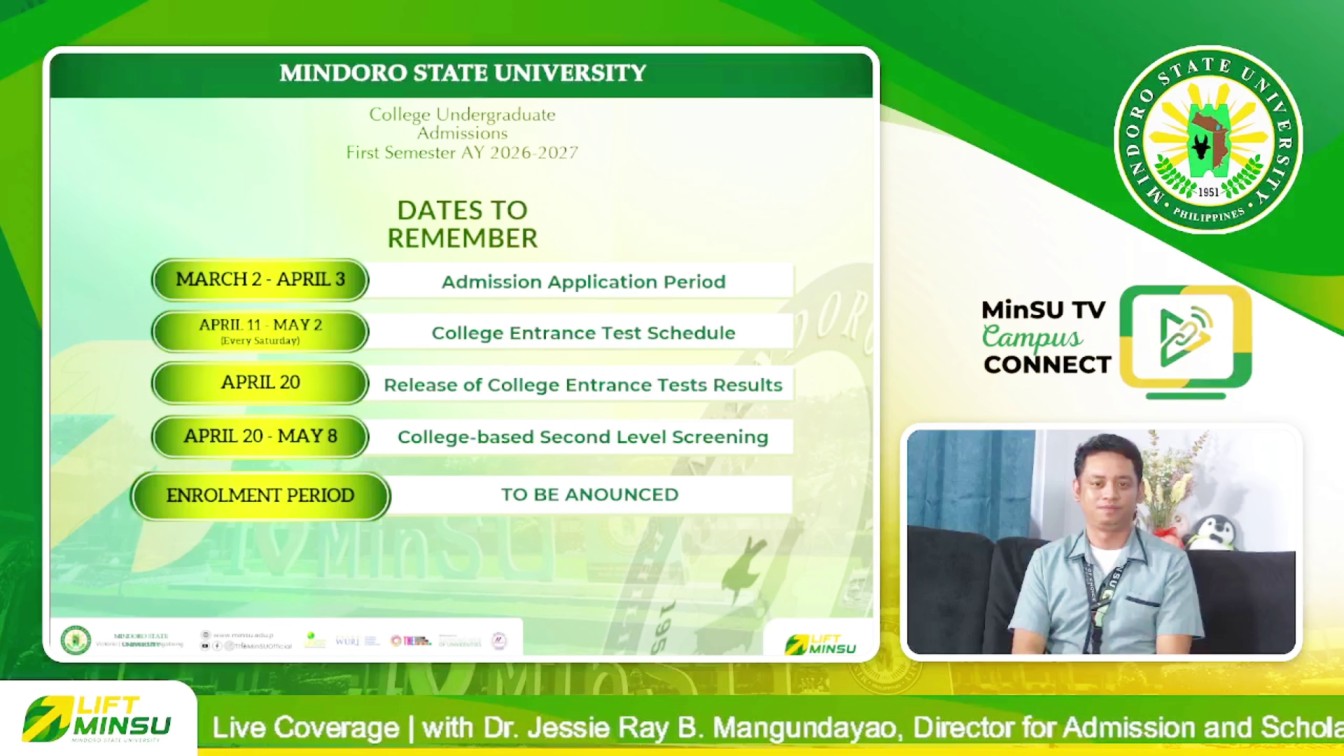
As thousands of aspiring MinSUans prepare for college admission, Mindoro State University (MinSU) laid down a comprehensive guidance on the admissions process, entrance examinations, program qualifications, and scholarship opportunities for Academic Year 2026–2027.
During a discussion led by Dr. Jessie Ray B. Mangundayao, Director for Office of Admission and Scholarship, applicants and parents were given a detailed overview of the admission timeline and answers to some of the most frequently asked questions surrounding college admission.
According to Dr. Mangundayao, the admission application period officially opened on March 2, 2026 and will run until April 3, 2026, followed by the conduct of the MinSU College Entrance Test every Saturday from April 11, 2026 to May 2, 2026. The release of entrance examination results will begin on April 20, while college-based second-level screening will be scheduled from April 20, 2026 to May 8, 2026.
He also emphasized that MinSU welcomes a wide range of applicants, including graduating Grade 12 students, senior high school graduates, transferees, second-degree takers, returnees, as well as Alternative Learning System (ALS) and Philippine Educational Placement Test (PEPT) passers who wish to pursue higher education.
One of the most common questions raised by applicants was whether admission to the University requires payment of application fees. The Office of Admission and Scholarship clarified that admission applications and entrance examinations are free of charge, consistent with the University's implementation of Republic Act No. 10931 or the Universal Access to Quality Tertiary Education Act.
The discussion also addressed concerns regarding the online admissions portal, particularly issues encountered by applicants during the opening days of registration. According to Mangundayao, the unusually high volume of users accessing the system resulted in temporary slowdowns, significantly exceeding the number of applications recorded during previous admission periods. Technical personnel have since implemented system improvements to accommodate the growing number of applicants.
They were likewise reminded to prepare the required documents before registration, including their Birth Certificate, academic records, and ID picture. Specific requirements vary depending on the applicant category, such as freshmen, transferees, ALS passers, or PEPT passers.
For applicants who may not have reliable internet access, the University clarified that walk-in applications remain available through the Office of Admission and Scholarship in all campuses. On-site applicants undergo the same registration process through the admissions portal, with personnel available to provide assistance when necessary.
The University also clarified that applicants must apply and take the entrance examination in the campus where they intend to enroll. Admission applications are campus-specific and cannot be transferred to another campus during the process.
Another FAQ involved entrance examination passing scores. Dr. Mangundayao explained that applicants must obtain at least a 65% score to qualify for non-board programs, while board programs require a minimum score of 75%. Under MinSU's Affirmative Action Program, Indigenous Peoples applicants, particularly the Mangyan community, are provided adjusted passing scores and additional support during the admissions process.
He also clarified that there is no quota during the application stage. However, academic programs maintain specific admission limits based on available faculty members, classrooms, laboratories, and other institutional resources. As a result, passing the entrance examination does not automatically guarantee admission to a particular program.
Applicants who successfully pass the entrance examination proceed to the second-level screening, which may involve interviews, written examinations, or other evaluation methods administered by the respective colleges. Priority is generally given to applicants with strong entrance examination scores and academic performance.
To further explain the selection process, the Office of Admission and Scholarship discussed the University's waiting-list system. Applicants who do not initially qualify for priority screening may be placed on a waiting list and considered if slots become available. Those who are not accommodated in their first-choice program may be referred to their designated second-choice course.
The University also clarified that transferees who have already earned at least 18 college units are generally exempt from taking the entrance examination, unless otherwise required by the program they intend to enter.
Beyond admissions concerns, Mangundayao highlighted the various scholarship opportunities available to MinSU students. Aside from the benefits provided under the Free Higher Education Act, students may qualify for external scholarship programs such as CHED's Tulong-Dunong Program and Tertiary Education Subsidy, Landbank scholarships, Malampaya Sustainable Scholarship, Open-heart Foundation Scholarship, and several institution-based scholarship and student assistantship programs.
As the admission season progresses, the Office of Admission and Scholarship advises applicants to carefully read official announcements, prepare documentary requirements early, and seek assistance whenever necessary to avoid delays in the application process.
Those who missed the live discussion may watch the full episode of MinSU TV Campus Connect on the University's official YouTube channel and social media platforms for a more detailed explanation of the admissions process and other concerns raised by prospective students and parents, https://youtu.be/d69HbYIdmRo?si=PH423EwU4Dd4I0aJ.
#SDG4 #SDG10
(kpic)

302 Staff

10531 Students

9 Colleges

3 Years